
Most injury claims settle weeks to months after the demand letter goes out. No nationwide rule sets a date, and the wait usually comes in pieces. The insurer has to read and answer your demand. You then go back and forth on the number. After you agree, the paperwork has to clear before a check is cut. Where your claim sits in that sequence, and which state's rules apply, tells you more than any single average.
The Short Answer: Weeks to Months, With No Single Deadline
No nationwide rule sets a date by which a settlement must arrive after a demand letter is sent. Timing depends on your state, the insurer and the facts of your claim.
The rough shape looks like this:
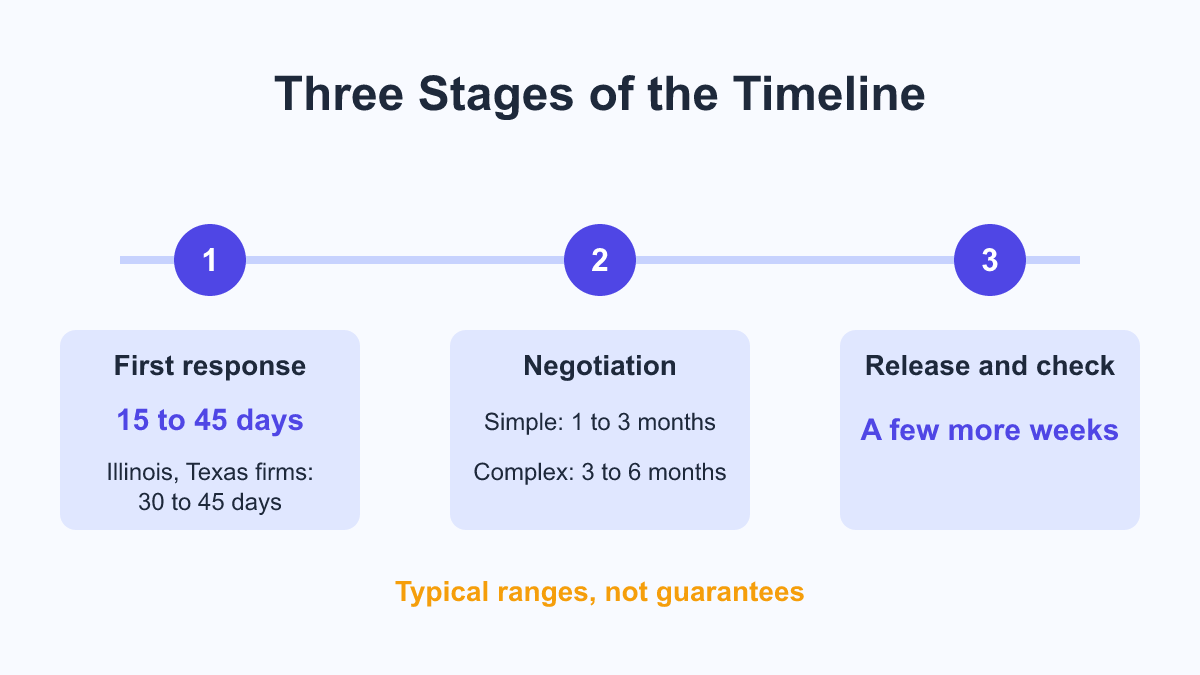
- First response: one legal guide puts most insurer replies at roughly 15 to 45 days, with complex or document-heavy files taking longer.
- Negotiation: offers and counteroffers go back and forth until a figure is agreed or talks stall.
- Release and payment: once a number is agreed, the release is signed, liens are confirmed and the check issues. That same guide says this takes a few more weeks.
How long the middle stage runs depends mostly on how clean your claim is. According to that guide, a clear-fault claim with clean records can reach an agreed figure within a month or two of the demand. Disputed liability or gaps in treatment can stretch the process to many months.
These ranges come from law firms and legal guides describing what they typically see. They are not official statistics. Rules on insurer response times also vary by state, so treat any figure as a general pattern rather than a promise for your claim.
The Three Stages of the Timeline
Stage 1: The insurer's first response
Different sources give different windows for the first reply, and each is one organization's estimate. Legal Tank puts most insurer responses at roughly 15 to 45 days. A guide from the legal software firm EvenUp describes an acknowledgment within about two weeks and a substantive response within several weeks. An Illinois firm and a Texas firm both say 30 to 45 days. Nobody has reconciled these ranges, so treat them as separate estimates.
Your demand letter likely set its own deadline. EvenUp mentions 15 to 30 days and Legal Tank two to four weeks. One Texas firm describes 30 business days from receipt. That same firm notes that a reply within 30 days does not mean a quick settlement.
Stage 2: Negotiation
Expect two or three rounds of counteroffers spread over weeks to months. For a $5,000 to $75,000 car claim, one Illinois firm says to expect 30 to 45 days for a first offer, then two to six more weeks of phone negotiation. The Texas firm uses a rough framework: 1 to 3 months of negotiation for simple cases, 3 to 6 months for complex ones, and 6 months to a year or more if the case is litigated. That framework is the firm's own view and is not drawn from published data. The auto accident settlement guide explains how claims are valued along the way.
Stage 3: Release and payment
Once you and the insurer agree on a number, the release is drafted and signed and any liens are confirmed. The check is then issued. Legal Tank says this usually takes a few more weeks.
| Stage | Typical window | Source |
|---|---|---|
| Acknowledgment | About 2 weeks | EvenUp |
| First response | 15 to 45 days | Legal Tank |
| First response | 30 to 45 days | Illinois and Texas firms |
| Negotiation, simple | 1 to 3 months | Texas firm |
| Negotiation, complex | 3 to 6 months | Texas firm |
| Litigated | 6 months to a year or more | Texas firm |
| Release and check | A few more weeks | Legal Tank |
What the Rules Actually Say About Insurer Response Times
Most of the deadlines people quote come from law firm websites. The actual time limits come from insurance regulations, and those depend on your state.
The NAIC model regulation
The NAIC Unfair Property/Casualty Claims Settlement Practices Model Regulation was issued in July 1997. It is a template, not a national law. It binds insurers only where a state adopts it, so states differ. It also creates no private right of action. You cannot sue an insurer just for missing one of its deadlines. Enforcement is by the state insurance regulator.
| Rule | Time limit | Applies to |
|---|---|---|
| Acknowledge claim notice | 15 days | Claims generally (unless paid sooner) |
| Reply to claimant communication | 15 days | Communications that call for a reply |
| Accept or deny | 21 days after proofs of loss | First-party claims |
| Status letter if more time needed | Every 45 days | First-party claims |
| Pay | 30 days | Once liability and amount are undisputed |
The difference between first-party and third-party claims matters. A first-party claim is one against your own insurer, and the 21-day decision and 45-day status letter rules apply there. A third-party claim goes to the other driver's insurer, and the model treats it differently. Work out which kind of claim you have before you count days. The model also requires written notice of a statute-of-limitations date at least 30 days before it expires for unrepresented first-party claimants, and 60 days for third-party claimants.
State examples: Illinois and California
In Illinois, one Illinois firm, Parker & Parker Attorneys, notes that no statute requires an insurer to answer a personal injury demand by a set date. Under that firm's reading, 215 ILCS 5/155 applies only in an action on a policy where delay is found vexatious and unreasonable, and 215 ILCS 5/154.6 covers good-faith handling without unreasonable delay.
For California, one legal software guide, EvenUp, summarizes 10 CCR 2695 as requiring acknowledgment within 15 calendar days and acceptance or denial within 40 days of proof of claim. Treat that as a summary and read the regulation itself before relying on it. The Texas firm's page cites no Texas rule at all.
Wherever you live, check your state's current insurance code or contact your state insurance department.
What Speeds Up or Slows Down a Settlement
The biggest single factor is how much the insurer has to argue about. According to Legal Tank, claims with clear fault and clean medical records can agree on a figure within a month or two of the demand, while disputed liability or gaps in treatment can stretch a claim to many months.
EvenUp's guide lists the common causes of delay: a demand package assembled at the end rather than built as you go, treatment that is still ongoing, disputed liability, policy limits or several claimants competing for the same coverage, and the volume of claims a carrier is handling. Two firm estimates add detail. One Illinois firm says large carriers may take three to seven business days before a demand package even reaches an adjuster's desk. One Texas firm says claims involving several parties often take 60 to 90 days for insurers to evaluate.
| Factor | Tends to speed up | Tends to slow down |
|---|---|---|
| Liability | Clear fault | Disputed fault |
| Treatment | Finished, no gaps | Unfinished or gaps |
| Documentation | Clean records, ready early | Package assembled at the end |
| Parties and policy limits | One claimant | Several claimants or limits at issue |
| Carrier workload | Lower volume | High volume |
| Liens and release | Confirmed before signing | Unresolved at the end |
Liens are confirmed before the check issues, so open questions about who must be repaid can hold up the final payment. Because a signed release generally cannot be reopened, it makes sense to confirm any liens and read exactly what the release covers before you sign. If a lawyer is handling your claim, how liens and costs come out of the recovery is worth asking about up front, and the guide to car accident lawyer fees explains how those arrangements usually work.
If the Other Side Goes Quiet or Says No
When the response deadline in your letter passes with no reply, it helps to escalate in a set order and keep a written record at each step.
- Call to confirm receipt. One Illinois firm, Parker & Parker Attorneys, usually makes its first follow-up call 7 to 10 business days after sending the letter, to confirm the insurer has it and to learn which adjuster is assigned. That is one firm's practice, not a rule.
- Follow up in writing. Send a short letter or email that restates your claim number, the date of your demand and the response you are waiting for.
- Ask for a supervisor if the adjuster stops replying or the file stays stalled.
- Use the state regulator. Under the NAIC model regulation, if an insurer rejects a claim and you object, it must tell you that you can ask the state insurance department to review it. In states that have adopted the model, you can also file a complaint with that department.
- Consider a lawsuit as the final step. The auto accident lawsuit process explains what filing involves.
The clock keeps running
Sending a demand does not pause the statute of limitations. In Illinois, for example, a personal injury suit generally must be filed within two years of the injury date under 735 ILCS 5/13-202. Deadlines differ by state, so confirm the one for your state before you rely on any date.
A deadline you set in your own letter is different. Nothing in the model rules attaches a penalty when it passes. The claim simply stays open, and your next steps are the written follow-up, a regulator complaint or filing suit.
What to Do Next While You Wait
Put three dates on your calendar now: the response deadline your demand letter set, the day you plan to make your first follow-up call, and the filing deadline for your state. That last one keeps running while you negotiate, and it differs from state to state, so look up the rule where your accident happened rather than relying on a general figure.
Keep your file ready to send. Unfinished treatment and a package pulled together at the last minute are both common causes of delay, so store medical records, bills and correspondence in one place and add new documents as they arrive.
Before you sign any release, find out which liens must be paid from the settlement and read exactly what the release covers. A signed release generally cannot be reopened later.
If fault is disputed, more than one party is involved, or the claim stalls despite your follow-ups, it may make sense to speak with a lawyer licensed in your state. The guide on how to find a good lawyer for a car accident explains what to look for.
Every timeframe in this article is a typical range, not a prediction for your claim. This is general information, not legal advice.