
The Truth About Uninsured Motorist Coverage: What It Pays, What It Doesn’t and How to Decide

Uninsured motorist coverage is the part of your own auto policy that pays you when the driver who caused the crash cannot, but it rarely works exactly the way people assume. Whether it fixes your car, whether you were required to buy it and whether you waived it years ago all depend on your state and the forms you signed. Checking your declarations page now is much easier than finding out after a crash.
What Uninsured Motorist Coverage Really Does
Uninsured motorist (UM) coverage pays you when the driver who caused the crash can't. Collision Help, a consumer insurance guide site, lists three situations where it applies: the at-fault driver has no insurance, a hit-and-run driver cannot be identified, or the at-fault driver's insurer is insolvent.
Underinsured motorist (UIM) coverage handles a related problem. The at-fault driver has insurance, but the limits are too low to cover your losses. UIM covers the shortfall.
How often you might need either one depends on how many drivers skip coverage. The Insurance Information Institute (Triple-I) estimates that about one in eight drivers carries no auto coverage, rising to about one in five in some states. Collision Help puts the national share at about 12.6%, which is that one site's figure. The Oklahoma Insurance Department describes the state's uninsured rate as among the highest in the nation.
Your own UM or UIM policy is what responds when the other driver's insurance is missing or too small. What it covers, how much it pays and whether you can turn it down all depend on your state and the wording of your policy, so the details differ from one driver to the next.
What It Pays: Injuries, Property Damage and Underinsured Gaps
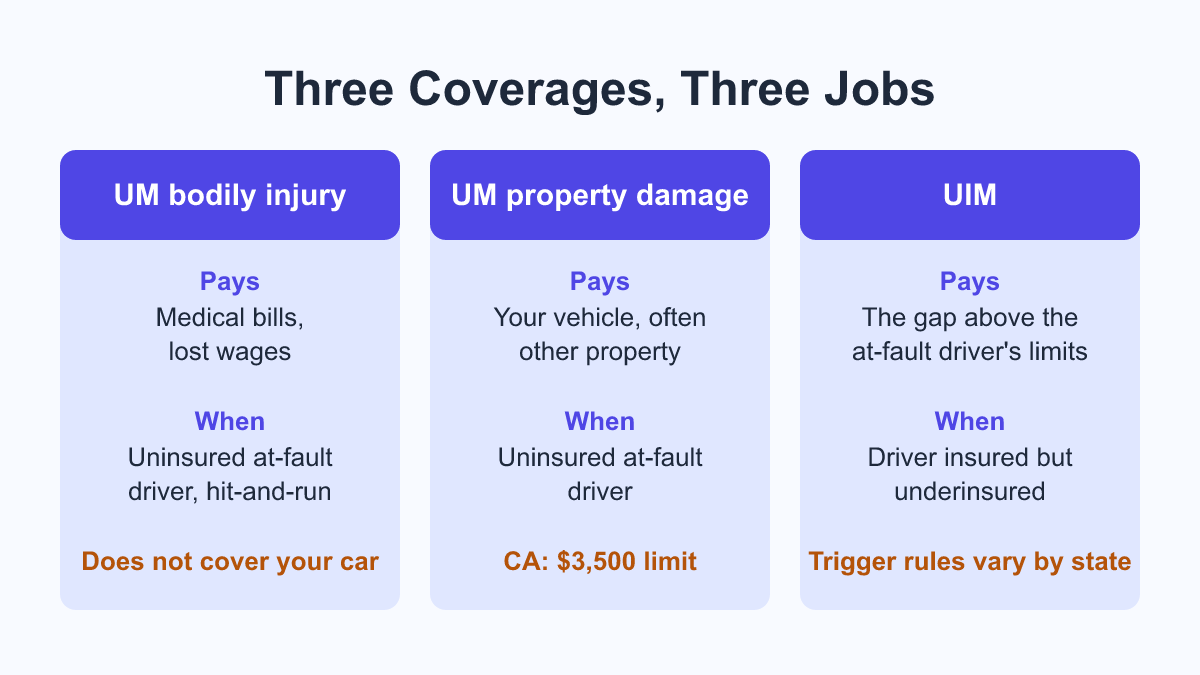
Uninsured motorist coverage is really a set of separate coverages. Each one pays for different losses, and what you can buy depends on your state.
| Coverage | What it pays | When it applies | Notes from sources |
|---|---|---|---|
| UM bodily injury | Medical bills, lost wages | Uninsured at-fault driver, hit-and-run | Does not cover your car |
| UM property damage | Your vehicle, often other property | Uninsured at-fault driver | CA: $3,500 limit; OK: limited availability |
| UIM | The gap above the at-fault driver's limits | At-fault driver insured but underinsured | Trigger rules vary by state |
Bodily injury
According to Triple-I, UM bodily injury pays your and your passengers' medical bills and lost wages when an uninsured driver causes the crash. It also applies if you are hit as a pedestrian or in a hit-and-run. It does not pay for damage to your car or other property. The Oklahoma Insurance Department says the same: UM/UIM there pays for medical care or loss of life, not vehicle repairs.
Property damage
UMPD pays for your vehicle and generally for other property too, such as a fence or house. Whether you can buy it depends on your state. The California Department of Insurance lists a $3,500 limit and says UMPD pays only if the uninsured driver is identified. It also says you may not need UMPD if you carry collision coverage. Oklahoma says UMPD is not widely available there. Sources give different advice on UMPD versus collision, so ask your insurer or your state insurance department how the two compare where you live.
Underinsured coverage
UIM applies when the at-fault driver has insurance but not enough of it. States decide when UIM kicks in in one of two ways. Collision Help describes these as a "damages trigger" and a "limits trigger," and calls the damages trigger more common and more favorable to consumers.
How much you can get also depends on whether your policy is "reducing." In an illustrative example from Collision Help, a $100K UIM policy minus $25K collected from the other driver leaves $75K. A non-reducing policy would bring the total to $125K.
Is It Required? 'Must Buy' vs. 'Must Offer' by State
Whether you must carry uninsured motorist coverage depends on your state, and the published counts don't line up. Collision Help, a consumer guide site, says 20-plus states require UM and most others require insurers to offer it. Triple-I says only a handful of states require uninsured coverage in all auto policies. Neither page explains the difference. Some states require the coverage, while others only require insurers to offer it, and rejection rules vary by state.
The broader requirement to carry car insurance is separate. Triple-I says every state except New Hampshire has a mandatory minimum car insurance requirement.
States where insurers must offer it
Collision Help lists California, Georgia, Ohio, Texas, Michigan and Florida as must-offer states. It says that in these states you typically have to reject UM in writing, so if you never signed a rejection, you may still have the coverage. Confirm this with your insurer or your state. The California Department of Insurance says you must sign a waiver form if you decline. The Oklahoma Insurance Department says insurers there must offer UM when you buy auto insurance.
A sample from one mandatory list
| State | Listed limit | Reject in writing? |
|---|---|---|
| Connecticut | 25/50 | No |
| Illinois | 25/50 | No (bodily injury) |
| Kansas | 25/50 | Yes |
| Maine | 50/100 | Yes |
| Vermont | 50/100 | Yes |
These figures come from Collision Help's table, which doesn't define the units, so check the exact limits with your state insurance department. The full table has 20 states plus D.C.
What It Costs and the Limits Worth Considering
The price of uninsured motorist coverage depends on your state, your insurer and the limits you choose. One firm, Collision Help, puts it at $20 to $50 per six-month term. That is a single company's estimate, not official data, so the reliable number is the one your insurer quotes you.
Choosing limits
Collision Help suggests matching your UM limits to your liability limits at a minimum, and considering $100,000/$300,000 or higher. That is its advice, not a legal rule. Ask for quotes at a few different limits and compare the difference in premium.
The drawbacks to know about
Coverage does not work the same everywhere. Stacking, which combines UM limits across vehicles or policies, is allowed in some states and not in others. Some states, such as Florida and New York, require that the hit-and-run vehicle physically touched yours. Collision Help lists these rules:
| State | Stacking allowed? | Physical contact required for hit-and-run? |
|---|---|---|
| California | No | No |
| Florida | Yes | Yes |
| Illinois | No | No |
| New York | No | Yes |
| Texas | No | No (for UM bodily injury) |
| Arizona, Delaware, Maryland, New Jersey, Ohio, Pennsylvania, Wisconsin | Yes | Not listed |
| Colorado, Georgia | No | Not listed |
Some states that allow stacking attach conditions to it. Check your own state's rules before you count on either feature.
New York adds another limit. Collision Help says UM there pays for pain and suffering only after a serious-injury threshold is met.
Skipping insurance carries risks of its own. The California Department of Insurance says driving without liability insurance in California can bring fines, license suspension and impoundment of your vehicle.
How an Uninsured Motorist Claim Works
An uninsured motorist claim is made against your own policy, so the process runs through your insurer rather than the other driver's. Collision Help lays out the usual sequence:
- Report the accident to your insurer.
- Give notice that you are making a UM claim.
- Provide documentation of the crash and your losses.
- Let the insurer investigate.
- Negotiate the amount.
- Use arbitration if you and the insurer cannot agree. The page says this applies "in many states," so check whether your policy or state uses it.
Keep copies of everything you send and get important answers in writing.
Watch the consent-to-settle terms
If the at-fault driver has some insurance and you expect to make an underinsured claim on top of it, read your policy before you accept anything from that driver's insurer. Collision Help says failing to follow consent-to-settle terms may void UIM coverage. The broader auto accident settlement process explains how those negotiations usually unfold.
What happens after you are paid
According to Collision Help, once your insurer pays, it may pursue the uninsured driver to recover its money, and you may share in any recovery.
Questions to settle with your policy and state
Some important points depend on your policy wording and your state's rules. These include whether UM still pays if you were partly at fault, how long you have to give notice or file, and what proof the insurer will accept that the other driver had no coverage. Ask your insurer for these answers in writing, or check with your state insurance department, before any time limit can become a problem.
What to Do Next
Start with your declarations page, the summary sheet at the front of your auto policy. Look for three lines: uninsured motorist bodily injury, underinsured motorist and uninsured motorist property damage. If any of them is missing, find out whether you ever signed a rejection form. In states where insurers must offer the coverage, Collision Help notes that if you never signed a rejection, you may still have it.
- Check what you carry. Note the limits listed for each coverage and any deductible.
- Ask about your state's rules. Your insurer or your state insurance department can tell you what is available, what limits and deductibles apply and how rejection works where you live. Triple-I says to ask them whether property damage coverage is available in your state. The California Department of Insurance and the Oklahoma Insurance Department both publish consumer guides.
- Get quotes at higher limits. Ask what the premium difference would be. If both property damage coverage and collision are offered, compare what each would pay for your car.
If you have already been hurt and the insurer disputes your claim, or your injuries are serious, it may make sense to speak with a licensed attorney in your state. Our guide on how to find a good lawyer for a car accident covers what to look for.
This is general information, not legal advice. Rules vary by state.